
Launch Your Career in Law Enforcement with a Criminal Justice AAS Degree
Are you ready for a career in law enforcement, corrections, or private security? The Criminal Justice AAS degree at Iowa Lakes prepares students with hands-on training, real-world experience, and career-focused coursework.
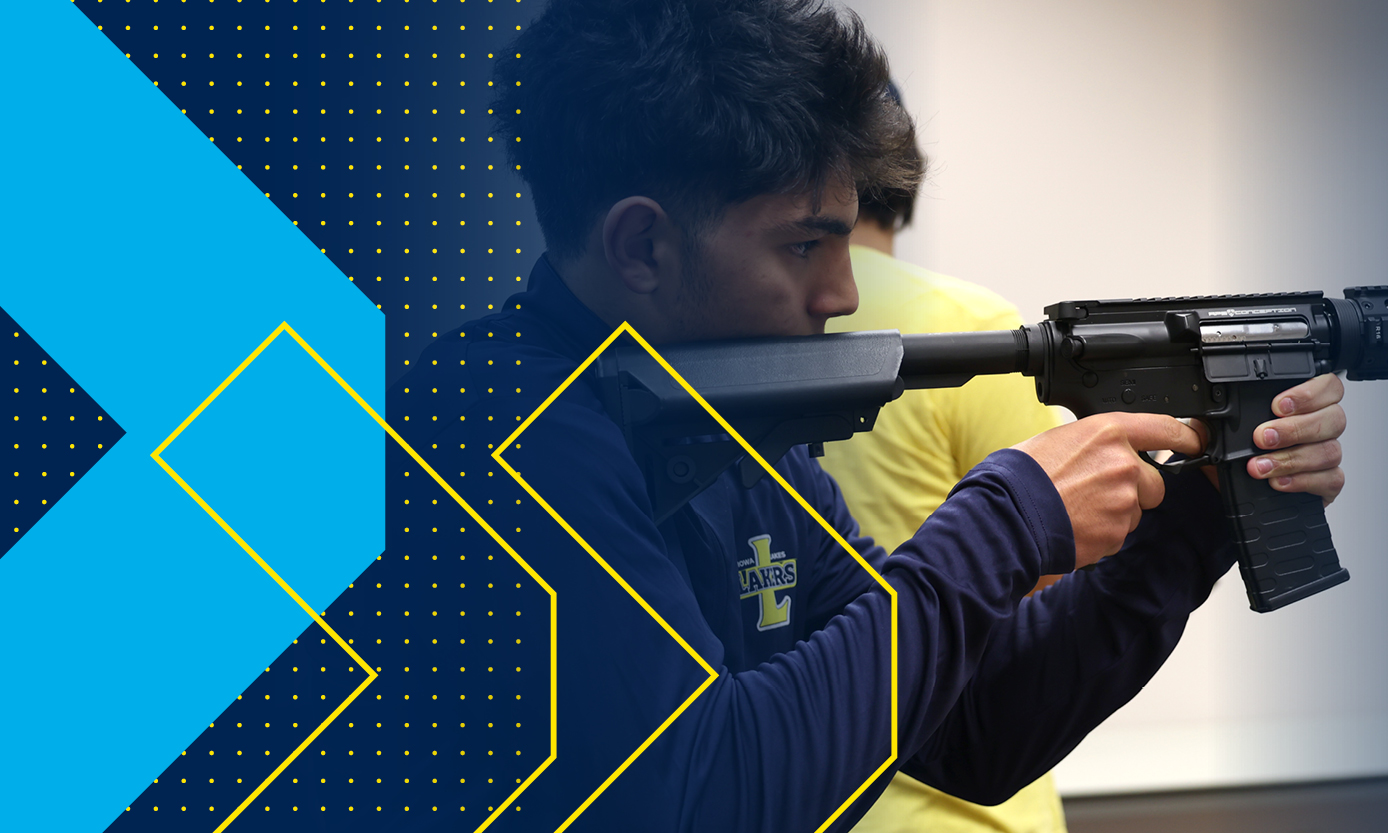
This two-year program blends classroom instruction, fieldwork, and simulation lab training. Students gain practical skills through defensive tactics in our mat room, firearms training at our indoor range and simulator, and investigative procedures using TraCS software. Certified adjunct instructors with law enforcement experience provide expert guidance in situational awareness, ethical decision-making, and problem-solving.
Iowa Lakes also offers in-service training for current law enforcement professionals. These courses help officers enhance skills, advance education, and complete academic training while staying in the workforce.
Graduates are well-prepared to enter the workforce immediately or transfer to a four-year institution for continued criminology, forensic science, or public administration education. Whether you aspire to be a police officer, correctional officer, private security professional, or loss prevention specialist, Iowa Lakes provides the knowledge, training, and professional connections to set you up for success.
Before enrolling, be sure to review your state’s minimum hiring standards for law enforcement. Iowa’s standards are in Section 550, Chapter I of the Iowa Administrative Code.
Explore career opportunities and salary projections through the U.S. Bureau of Labor Statistics Criminal Justice Outlook.
Connect with an enrollment coach today and take the first step toward a fulfilling career in law enforcement!

Find Your It!
Hands-On Training & Career Pathways
Gain the Skills You Need for a Career in Criminal Justice
The Criminal Justice AAS program at Iowa Lakes provides students with in-depth training in:
- Law Enforcement Practices – Learn police procedures, criminal law, and investigative techniques
- Corrections & Rehabilitation – Study inmate management, crisis intervention, and rehabilitation programs
- Private Security & Loss Prevention – Develop skills in risk assessment, surveillance, and asset protection
- Indoor Firearms Range & Simulator – Hands-on training from Certified Adjunct Instructor
- Ethics & Criminal Law – Understand the legal and ethical considerations of working in the justice system
- Crime Scene & Forensic Investigative Procedures – Train in evidence collection, criminal profiling, crime scene analysis, and utilizing Traffic & Criminal Software (TraCS)
Real-World Experience & Workforce Readiness
Students at Iowa Lakes gain practical law enforcement experience through:
- Simulation Labs – Hands-on training in use-of-force scenarios, crisis de-escalation, and investigative procedures
- Fieldwork & Internships – Opportunities to work with local law enforcement agencies, correctional facilities, and security firms
- In-Service Training – Continued education for current law enforcement officers looking to advance their careers
Program Details
Length

5 terms
Degree
Associate in Applied Science (60 credits)
Campus
Estherville
Training
Internship/Practicum
Your Career Pathway: Additional Degree & Certificate Options
Additional Information
Term 1
CRJ 100 – Intro to Criminal Justice
Survey of the American criminal justice system, the early, middle and late stages of the criminal justice system are analyzed within the framework of law and research.
CRJ 201 – Juvenile Delinquency
Juvenile justice system is examined from historical constitutional and operational perspectives. Theories concerning juvenile delinquency are explored.
ENG 105 – Composition I
Emphasis on expository and argumentative writings including a review of usage and mechanics.
Prerequisites: Satisfactory score on the ACT, Accuplacer, ASSET, COMPASS as determined by Iowa Lakes policy
PEH 225 – Healthy Lifestyles Management
Living a healthy lifestyle, a basic overview of fitness activities, the health benefits of fitness activities, nutrition and stress. Each unit contains basic information, choices and application toward establishing a healthier lifestyle.
SPC 101 – Fundamentals of Oral Communication†
The fundamentals course develops the basic skills involved in a variety of communication situations, including oral presentations and interpersonal speaking. Emphasis is placed on organization, audience analysis, vocal and physical delivery, listening, nonverbal communication, critical thinking, and methods of dealing with communication apprehension through class discussion and activities.
Term 2
CRJ 120 – Intro to Corrections
Survey of correctional theory and practice including such topics as: historical foundations of contemporary corrections, applied theory, evaluation research, sentencing and crime prevention.
CRJ 200 – Criminology
Scientific study of the nature and causes of criminal behavior and social deviance.
CRJ 214 – Survival Spanish for Criminal Justice
This program is designed to provide non-Spanish-speaking criminal justice students and police officers with functional skills in Spanish. Spanish phrases, commands, and questions practical to daily police and corrections work are covered. No prior knowledge of Spanish necessary.
PEA 143 – Physical Conditioning I
This is an introductory course designed to provide the physical fitness basic skills to assist students in their preparation for the minimum physical fitness requirements in Criminal Justice field.
PEA 146 – Phys. Fitness I
Develops an individual wellness program with emphasis on cardiovascular and muscular fitness and provides the student with periodic fitness evaluations.
SPC 112 – Public Speaking
This course examines both the theoretical and practical basis of speech communication, particularly public speaking. Emphasis is placed on speech preparation, organization, support, delivery, and audience analysis.
Choose PEA 143, or PEA 146
MATH: 3 credits
Term 3
CRJ 219 – Field Experience
This course is designed to provide preparation for students with on-the-job experience in a criminal justice related field. The student will learn basic requirements and expectations of the criminal justice profession and within the agency setting.
Term 4
CRJ 130 – Criminal Law
This course examines the elements of criminal law. Including the categories of crime by type, defenses, and individuals involved. The course also includes the historical development of criminal law.
Prerequisites: CRJ 100 – Intro to Criminal Justice
CRJ 141 – Criminal Investigation
Covers fundamentals of investigation including interviewing and interrogating; collecting and preserving evidence; modus operandi; crime scene search; etc.
CRJ 207 – Drug Use and Abuse
Designed to help the student understand sociological aspects of drug use, abuse and treatment.
ENG 106 – Composition II
Continuation of ENG 105 with emphasis on research and documentation as well as literary analysis.
Prerequisites: ENG 105 – Composition I
PSY 111 – Intro to Psychology†
An introduction to the scientific study of behavior; a brief history of psychology as a science, and topics fundamental to human behavior including developmental issues, sensory abilities, cognitive performance, social and emotional factors in behavior, and abnormal behavior and therapies.
Term 5
CRJ 151 – Defensive Tactics
This course provides instruction on presence, communication, self-defense, control and use of force techniques necessary for law enforcement. Emphasis is placed on physical fitness, officer safety, and criminal and civil liability.
CRJ 220 – Community-Based Corrections
Presents the theoretical and philosophical basis of probation, parole and other community based correctional programs.
CRJ 248 – Firearms
Introduction to police firearms safety and care; use of deadly force; chemical agents; firing range safety; latest techniques of combat shooting; and recreational shooting.
CRJ 902 – Criminal Justice with the Expert
Supplemental enrichment course related to Criminal Justice which may include special projects or papers.
SOC 110 – Intro to Sociology†
A survey course applying basic sociological concepts, theories, and methods to examine society, culture, cultural institutions, cultural diversity, and cultural stability and change.
General Education & Program Learning Outcomes
In the Criminal Justice program at Iowa Lakes, you will learn:1
- Explain how constitutional concepts apply to the criminal justice system.
- Apply knowledge of the criminal and civil law to situations encountered in the field.
- Model an ethical framework at both the personal and system level.
- Assess rapidly evolving or changing situations.
- Use verbal, non-verbal, and written communication in a criminal justice context.
- Cultivate physical and mental health.
- Support the concept of service to the community.
- Apply basic investigative and procedural techniques to practical situations.
1The What You’ll Learn section of our website provides a description of Learning Outcomes for students who successfully complete all requirements for obtaining a Criminal Justice Associate in Applied Science degree from Iowa Lakes Community College.
Iowa Lakes Criminal Justice students are well-prepared to meet the Iowa Law Enforcement Academy’s (ILEA) physical fitness standards through structured coursework and hands-on training. The program integrates physical conditioning, defensive tactics, and endurance-building exercises to help students develop the strength, stamina, and agility required for law enforcement roles. By incorporating fitness training and scenario-based exercises, Iowa Lakes ensures that graduates are physically and mentally prepared to meet or exceed ILEA standards and excel in their future law enforcement careers.
Preparing for the Demands of Law Enforcement
Iowa Lakes provides Criminal Justice students access to a dedicated weight training facility designed specifically for their law enforcement fitness needs, featuring:
- Free weights, resistance machines, and cardio equipment to improve strength and endurance
- Structured workouts aligned with ILEA fitness standards for optimal preparation
- Physical conditioning, defensive tactics, and agility training integrated into the curriculum
- A law enforcement-focused fitness environment to develop physical resilience and tactical readiness
Mat Room – Defensive Tactics Training
- Full wrestling mat room inside the Criminal Justice building
- Hands-on defensive tactics instruction and interaction
- Training is led by a certified adjunct instructor and a local law enforcement officer
- Students develop essential skills in:
- Personal safety
- Situational awareness
- Law enforcement defensive techniques

Hands-On
Training
Career-Ready
Day One
Opportunities, Earnings & Growth

Projected Employment Growth
.3%
Potential Careers
Correctional Officer, Police Officer, Emergency Management, Immigration and Customs, Security, Regulatory Affairs, Loss Prevention Specialist, DNR Officer
Projected Earnings
Iowa Workforce
$70,532
Average Salary
US Bureau of Labor
$76,550
Average Salary

START YOUR LAKER JOURNEY IN 4 STEPS!




Questions? Let's Talk
 |
Molly Struve Dean of Arts & Sciences and Academic Success 712-362-7935 | mstruve@iowalakes.edu |