

Ignite Your Culinary Career with a Culinary Arts Diploma
Are you passionate about cooking and eager to realize your culinary dreams? The Culinary Arts Diploma at Iowa Lakes Community College offers a comprehensive, hands-on program designed to equip you with the essential skills and knowledge for a thriving career in the culinary industry. Over three terms, you’ll immerse yourself in both the art and science of cooking, gaining practical experience in various culinary techniques and kitchen operations.
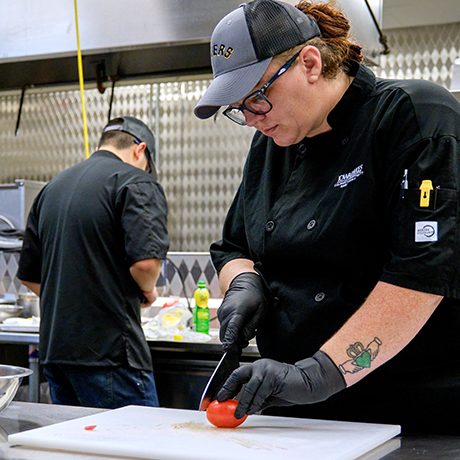
Our curriculum covers various topics, including knife skills, baking and pastry arts, Midwest cuisine, and menu planning. You’ll learn to prepare diverse dishes, understand flavor profiles, and master cooking methods fundamental to any professional kitchen. Additionally, the program emphasizes front-of-house operations, providing you with a holistic understanding of the food service industry. This well-rounded approach ensures you’re prepared to excel in various culinary settings, from restaurants and hotels to catering companies.
As you learn the ropes of the culinary industry in our top-notch facilities, you’ll gain experience particularly in Midwest cuisine. You’ll have access to two fully equipped kitchens with combi ovens, steam tables, dual platinum grills, broasters, tenderizers, mixers, convection ovens, and more.
Culinary Arts – Career Opportunities
The best part is that employment and placement rates are exceptional for students in our program. Ninety-five percent of graduates have been placed in an industry demanding new employees. You can rest assured there will be a need for you in the workplace.
Upon completion of the program, graduates are well-positioned to enter the workforce confidently. The culinary field offers a variety of career paths, including roles such as line cook, pastry chef, kitchen manager, and food service supervisor. With the hands-on experience and comprehensive training Iowa Lakes provides, you’ll be equipped to pursue these opportunities and embark on a rewarding culinary career.
Explore career opportunities and salary projections through the U.S. Bureau of Labor Statistics Culinary Careers Outlook.
This program is not currently accepting students for Fall 2026. Please check back for future enrollment opportunities. Connect with an enrollment coach today and learn about other opportunities that may be interesting to you!

Find Your It!
Explore Culinary Excellence at Iowa Lakes
Develop Essential Culinary Skills
The Culinary Arts Diploma program at Iowa Lakes offers in-depth instruction in:
- Culinary Techniques: Master fundamental cooking methods, including sautéing, grilling, roasting, and braising.
- Baking and Pastry Arts: Learn the art of bread making, pastry creation, and dessert preparation.
- Menu Planning and Development: Gain expertise in designing menus that are both appealing and cost-effective.
- Kitchen Management: Understand inventory control, cost management, and kitchen safety protocols.
Real-World Experience
Our program includes practical lab sessions and opportunities to participate in campus events, allowing you to apply classroom knowledge in real-world settings. This hands-on approach ensures you’re well-prepared to meet industry demands upon graduation.
Program Details
Length

3 Terms
Degree
Diploma (34 credits)
Campus
Emmetsburg
Your Career Pathway: Additional Degree & Certificate Options
Additional Information
Term 1
HCM 108 – Food Safety & Sanitation
This course addresses the responsibility of a food service worker/hospitality employee and the Safety and Sanitation knowledge required in the food and hospitality industry. Students will learn how to identify unsafe conditions and know various ways to correct or prevent them in the workplace. They will also take a national exam which will allow them to achieve the ServSafe Manager certificate, which is recognized across all 50 states.
HCM 154 – Basic Food Preparation
This course teaches students the basic skills of grilling, frying, broiling, sauteing, vegetable cookery, recipe conversion, recipe costing, and creating soups and stocks. This course will identify standard equipment used in the food industry and how to set up, operate, break down, and clean the equipment.
HCM 200 – Dining Service
Dining service provides an avenue for personal and professional growth. The areas surveyed include grooming, appearance, attitude, and behavior. Related topics include setting up for service, serving the customer, taking orders, and cashiering, which occurs in catering functions and food service dining.
HCM 265 – Mathematics for Hospitality
Reviews the fundamentals of mathematics, including methods of figuring percent, discount, mark-up, mark-down and interest. Problems related to the hospitality industry.
HCM 298 – Knife Skills
This course offers instruction in the proper use of knives and other culinary equipment and allows gradual growth and confidence in ability with the tools of the trade and allows all students to become proficient in this most important of tasks.
SPC 101 – Fundamentals of Oral Communication†
The fundamentals course develops the basic skills involved in a variety of communication situations, including oral presentations and interpersonal speaking. Emphasis is placed on organization, audience analysis, vocal and physical delivery, listening, nonverbal communication, critical thinking, and methods of dealing with communication apprehension through class discussion and activities.
SPC 112 – Public Speaking
This course examines both the theoretical and practical basis of speech communication, particularly public speaking. Emphasis is placed on speech preparation, organization, support, delivery, and audience analysis.
SPC 122 – Interpersonal Communications
Examines how humans communicate in one-on-one situations through personal and professional relationships.
Choose SPC 101, SPC 112, or SPC 122
Term 2
BUS 161 – Human Relations†
Students are given the opportunity to apply human relations concepts and evaluate experience and observations. Social skills required in various occupational settings will be developed, emphasizing how appropriate personal attitudes lead to social and business success.
CSC 110 – Intro to Computers
CSC-110 is an introductory course that surveys a variety of topics to include history, hardware, software, terminology, communications, computer ethics, and societal impact of computers. In addition to computer literacy, students will complete hands-on modules using operating systems, word processing, database, presentation, and spreadsheet software; such as Microsoft Office programs.
BCA 212 – Intro to Comp Business Apps
In a Windows environment, the focus of this course is to use hardware and software as business productivity tools. Training includes a hands-on introduction to computer applications vital in business and industry . The course covers computer terminology, operating system, email, and Internet applications . Hands on training is provided for software business applications including word processing, spreadsheet, database, and presentation software.
HCM 117 – Bakery Basics
Provides baking methods and lab experience in preparing bakery products. Emphasizes yeast products, quick bread, pies, cakes, pastry doughs, custards, puddings, and cookies. Stresses bakery procedures, weighing, measuring, using and care of equipment, sanitation, safety, simplifying work, costing, and producing high-quality baked products.
HCM 222 – Convenience Foods
Convenience Foods studies a variety of convenience items on the market today and teaches students methods for altering these products to improve quality and flavor. This course examines methods of incorporating these items in menus for time saving and consistency. Students evaluate cost and quality compared to scratch baking.
HCM 292 – Food Preparation
This course offers instruction in the fundamentals of basic cooking skills, use of equipment, kitchen safety and basic recipes that are foundations for all culinary learning.
MGT 101 – Principles of Management†
Principles of Management provides the student with a conceptual framework for understanding the basic theories of management. Emphasis is placed on the internal and external environment, ethics, planning, goal setting, decision making, organizational structure, motivation and group dynamics, and effective control mechanisms for establishing and accomplishing business objectives.
Choose CSC 110 or BCA 212
Term 3
HCM 939 – Workplace Experience I
Workplace experience (on-the-job training), is usually full-time, in a hotel, motel, restaurant or related business.
Prerequisites: Hotel/ Motel Restaurant Management Student and successful completion of Sanitation exam
General Education & Program Learning Outcomes
In the Culinary Arts program at Iowa Lakes, you will learn how to:1
- Calculate the cost per portion of given recipes and measurements/weights
- Prepare an effective cover letter & resume
- Acquire a realistic experience working in the Hospitality Industry
- Distinguish between different hand tools, utensils and equipment
- Operate hand tools, utensils and equipment properly
- Determine the quality of a guest experience
- Convert recipes to yield different amounts
- Identify proper storage areas for food and nonfood items
- Demonstrate proper sanitation procedures
- Demonstrate teamwork by taking initiative in completing tasks or assisting other team members
- Recognize workplace legal requirements
- Classify nutrients and diets for medical nutrition therapy
Industry Certifications & Accreditation
Graduates of the Culinary Arts Diploma program at Iowa Lakes Community College can earn industry-recognized certifications that enhance their skills and career prospects in the hospitality and food service industries.
American Hotel & Lodging Association (AHLA) Certifications:
- Housekeeping Management – Best practices for maintaining cleanliness and efficiency in hospitality settings
- Managing Front Office Operations – Essential skills for front desk management and guest relations
- Controlling Alcohol Risks Effectively (CARE) – Responsible alcohol service training for hospitality professionals
- Managing Beverage Operations – Knowledge of beverage management, mixology, and service standards
National Restaurant Association (NRA) Certifications:
- Customer Service – Training in hospitality standards and guest satisfaction
- Purchasing – Understanding procurement and inventory control for food service operations
- ServSafe Manager – Food safety and sanitation certification required by many employers
- Nutrition – Principles of healthy menu planning and dietary guidelines
- Human Resource Management & Supervision – Leadership training for managing kitchen and front-of-house staff
- Controlling Foodservice Costs – Financial management strategies for restaurant operations
- Hospitality & Restaurant Management – Comprehensive training in food service leadership and business operations
Accreditation:
The Culinary Arts program at Iowa Lakes is accredited by the American Hotel & Lodging Association (AHLA) and the National Restaurant Association (NRA), ensuring students receive high-quality, industry-aligned education that meets professional standards in the culinary and hospitality fields.
Diverse Career Opportunities
Graduates are equipped to pursue roles such as:
- Line Cook: Prepare and cook menu items in various dining establishments.
- Pastry Chef: Specializes in creating baked goods and desserts.
- Kitchen Manager: Oversee kitchen operations, including staff management and inventory control.
- Catering Coordinator: Plan and execute food services for events and special occasions.
With the culinary industry continually evolving, Iowa Lakes’ Culinary Arts Diploma program provides the skills and experience necessary to excel in this dynamic field.
The Culinary Arts program at Iowa Lakes is the longest-running program of its kind in Iowa, continually updating its curriculum to meet the evolving needs of the culinary industry.

Hands-On
Training
Career-Ready
Day One
Opportunities, Earnings & Growth

Projected Employment Growth
.8%
Potential Careers
Cook or chef, Front Desk Personnel, Night Auditor, Dietetic Aide, Food and Beverage Supervisor, Assistant Management, Front of House and Back of House Managers
Projected Earnings
Iowa Workforce
$69,721
Average Salary
US Bureau of Labor
$69,580
Average Salary

START YOUR LAKER JOURNEY IN 4 STEPS!




Questions? Let's Talk
 |
Jesse Grossnickle Director of Dining Services 712-852-5256 | jgrossnickle@iowalakes.edu |