

Fast-Track Your Career with an HVAC Technician Diploma
As the demand for energy-efficient and sustainable climate control systems continues to rise, skilled HVAC technicians are more essential than ever. The Heating, Ventilation & Air Conditioning (HVAC) Technology Diploma program at Iowa Lakes Community College provides hands-on training and industry certifications to prepare you for a dynamic and in-demand career in this essential field.
In just three terms, you’ll gain real-world experience working with modern HVAC equipment and learning to install, maintain, and repair heating, ventilation, air conditioning, and refrigeration systems. The curriculum emphasizes energy efficiency, system automation, and sustainable HVAC technologies, ensuring graduates are prepared to meet today’s industry challenges. Iowa Lakes also provides training in electrical systems, blueprint reading, and diagnostics, equipping students with well-rounded technical expertise.
Located at our Estherville campus, this diploma program includes a built-in internship/practicum, allowing students to apply their skills in real-world settings. Through Iowa Lakes’ strong industry partnerships, students gain on-the-job training with HVAC contractors, service providers, and energy efficiency firms, helping them transition seamlessly into the workforce. Many graduates secure employment before completing the program, thanks to Iowa Lakes’ connections with top industry employers.
The HVAC Technician Diploma program at Iowa Lakes supports workplace training needs in sustainable energy, natural resource management, and industrial technology, providing graduates with job security and opportunities for career advancement. With the HVAC industry expected to grow 9% by 2033, there’s never been a better time to start your journey toward a high-paying and stable career.
Explore career opportunities and salary projections through the U.S. Bureau of Labor Statistics HVAC Technician Outlook.
Connect with an enrollment coach today and take the first step toward a rewarding career in HVAC technology!

Find Your It!
Hands-On Training & Career Pathways
Comprehensive HVAC Training
The HVAC Technology Diploma program at Iowa Lakes offers in-depth instruction in:
- Energy-Efficient Systems: Learn to design and implement sustainable HVAC solutions.
- Advanced Diagnostics: Develop skills to troubleshoot and repair complex HVAC systems.
- Electrical and Blueprint Reading: Gain proficiency in interpreting schematics and electrical diagrams.
- System Installation and Maintenance: Master the techniques of installing and servicing various HVAC equipment.
Real-World Experience
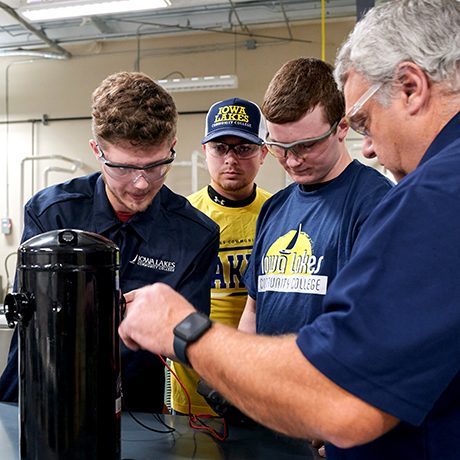
Our program includes a practical experience during the summer term, allowing you to apply classroom knowledge in real-world settings. This hands-on approach ensures you’re well-prepared to meet industry demands upon graduation.
Diverse Career Opportunities
Graduates are equipped to pursue roles such as:
- HVAC Technician: Install, maintain, and repair heating and cooling systems in residential and commercial settings.
- Energy Efficiency Consultant: Advise clients on optimizing HVAC systems for energy savings.
- HVAC System Designer: Develop plans for new HVAC installations focusing on sustainability.
Program Details
Length

3 terms
Degree
Diploma (34 credits)
Campus
Estherville
Your Career Pathway: Additional Degree & Certificate Options
Additional Information
Term 1
HCR 102 – Intro to HVAC
An introduction to HVAC systems, with an emphasis on electrical and mechanical fundamentals skills, including AC and DC electricity; electrical power supplies and wiring materials; meter operations; mechanical math and measurement; fasteners; and PVC assembly.
Prerequisite: SER 124 – Industrial Safety
HCR 112 – Heating Fundamentals
This course covers fundamental principles and skills for all common heating systems. This course is a combined lecture and lab course and includes discussions and demonstrations in heating fundamentals. Safety is greatly emphasized as students are working with actual voltages, and working equipment.
Corequisite: HCR 102 – Intro to HVAC
HCR 305 – Fundamentals of Refrigeration
This course is a combined lecture and lab course covering the theory and laws governing refrigeration, the operation of refrigeration systems, heat transfer, components, and test equipment. It also covers the different soldering and brazing methods and materials used in refrigeration service. Emphasis is on the recovery, recycling and charging methods used.
Prerequisites: HCR 102 – Intro to HVAC and SER 124 – Industrial Safety
MAT 743 – Technical Math
Technical Math includes operations with real numbers, use of fractions, ratios, measurement conversion, algebraic equations, functions, geometry, and right angle trigonometry. Applications are designed around situations students may encounter in industrial settings
SER 116 – Career Seminar
A study of the careers available within the renewable energy sector, with an emphasis on analyzing renewable energy industries as related components of a dynamic system. Students will also learn about drafting cover letters, creating resumes, interviewing, and networking.
SER 124 – Industrial Safety
A study of principles and practices used to establish a safe and efficient environment for personnel in the renewable energy industry and various sectors thereof. The course focuses on general industrial safety, safety and health regulatory agencies and organizations, hazard recognition and correction, and first aid.
Term 2
COM 753 – Technical Communications†
This course is designed to prepare students for the oral and written communication situations in the working world. The major areas of study include technical communication principles, oral communications, composing technical documents, and using Standard English. Writing projects require the use of a word processing program; therefore, computer experience is recommended.
ELE 195 – Motor Control
This course discusses motor controls, components, operation, and service. Students will learn electric relay control of AC and DC motors along with troubleshooting motors in an industrial application.
HCR 115 – Residential Heating Systems
The purpose of this course is to introduce the student to the various types of residential heating systems. Areas and concepts covered include combustion theory, basic air distribution, furnace construction, filters, humidifiers, installation techniques, and maintenance procedures.
Prerequisites: HCR 102 – Intro to HVAC and HCR 112 – Heating Fundamentals
HCR 125 – Oil & Hydronic Heating
This course is a combined lecture and lab course studying the theory and applications in electrical resistance and oil and hydronic heating systems as they relate to residential and commercial heat loss requirements. Studies include installation, troubleshooting wiring and control circuits.
Prerequisite: HCR 112 – Heating Fundamentals
HCR 205 – Air Conditioning Principles
This course is a combined lecture and lab course which deals with the fundamentals of residential air conditioning systems. Emphasizes system components, types of refrigerants, principles of heat transfer, and diagnosis and repair of various systems used in the air conditioning industry. Studies relationship to temperature and pressure variance including psychrometric comparison as applied to commercial and residential air conditioning.
Prerequisites: HCR 102 – Intro to HVAC and SER 124 – Industrial Safety
Term 3
HCR 932 – Internship
On the job training for Heating, Air Conditioning, and Ventilation program.
Prerequisites: HCR 102 – Intro to HVAC
General Education & Program Learning Outcomes
In the Heating, Ventilation & Air Conditioning (HVAC) program at Iowa Lakes, you will learn how to:1
- Apply industrial safety practices for the Heating Ventilation Air Conditioning (HVAC) field
- Interpret electro-mechanical system schematic diagrams
- Install HVAC electro-mechanical systems
- Fabricate properly sized HVAC piping systems
- Fabricate properly sized HVAC ducting systems
- Maintain HVAC electro-mechanical systems
- Troubleshoot HVAC electro-mechanical systems
1The What You’ll Learn section of our website provides a description of Learning Outcomes for students who successfully complete all requirements for obtaining a Heating, Ventilation, & Air Conditioning diploma from Iowa Lakes Community College.
Industry Certifications & Workforce Readiness
Employers seek highly trained and certified HVAC technicians, and Iowa Lakes ensures that students earn industry-recognized credentials, such as:
- EPA Section 608 Refrigerant Handling Certification
- OSHA 10 & OSHA 30 Safety Certifications
- HVAC Industry Standards and Code Compliance Training
Through strong industry partnerships, students gain on-the-job experience and have the opportunity to work with HVAC contractors and service providers, ensuring they graduate with real-world experience and job-ready skills.
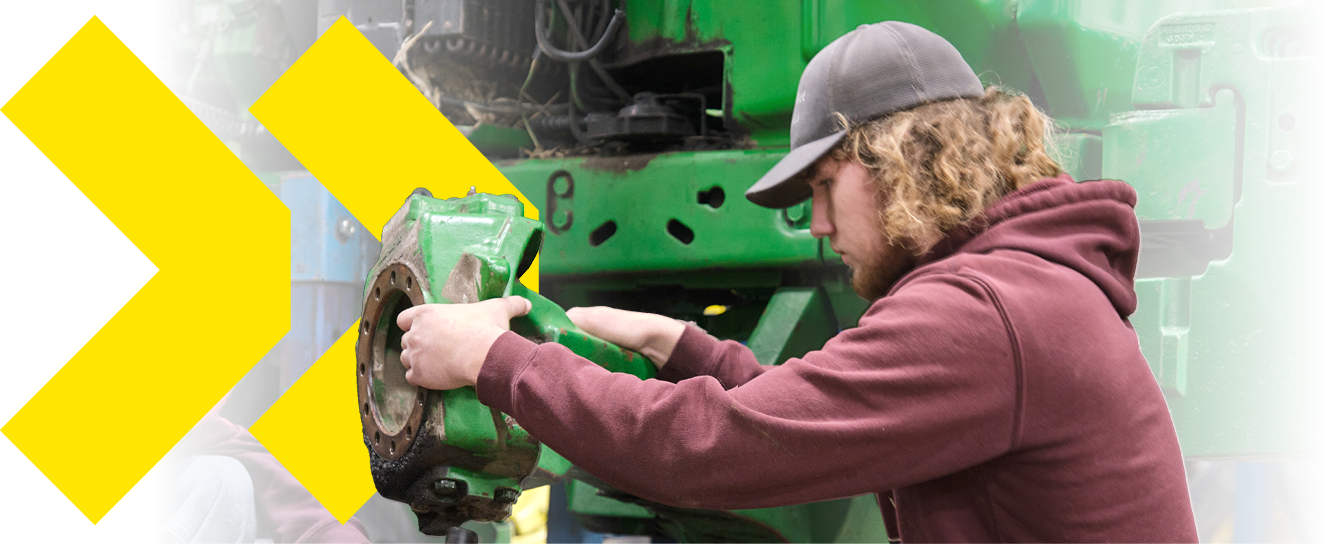
The HVAC Technology program at Iowa Lakes allows students to work on real climate control systems, gaining hands-on experience with energy-efficient and smart HVAC technologies—preparing them for careers in the future of climate control and sustainability!
Hands-On
Training
Career-Ready
Day One
Opportunities, Earnings & Growth

Projected Employment Growth
.4%
Potential Careers
Energy Auditor, Residential Appliance Repairer, Refrigeration Mechanic/ Installer, Heating and Air Conditioning Mechanic/Installer, First-Line Supervisor of Mechanics/Installers/Repairers, Pipe Fitter & Steamfitter, Cooling & Freezing Equipment Operator/Tender
Projected Earnings
Iowa Workforce
$57,928
Average Salary
US Bureau of Labor
$59,620
Average Salary

START YOUR LAKER JOURNEY IN 4 STEPS!




Questions? Let's Talk
 |
Troy Brandt Heating, Ventilation, and Air Conditioning Technology Instructor/Coordinator 712-362-8390 | tbrandt@iowalakes.edu |