
Turn Creativity Into a Career in Media

Find Your It!
Launch a Career in Communications!
Digital, Social & Broadcast Productions
Comprehensive Curriculum Designed for Success
The Digital, Social & Broadcast Productions curriculum combines technical skills, creative storytelling, and industry knowledge to prepare you for a well-rounded career in media. Courses cover everything from video production and audio editing to digital marketing strategies and broadcast writing. You’ll also explore emerging trends in social media and learn how to adapt content for various audiences and platforms. Whether you’re creating a short film, crafting engaging posts for social channels, or managing a live broadcast, Iowa Lakes provides the foundation for success.
Plan Your Future with Iowa Lakes
Our academic advisors are ready to guide you in building a personalized degree path to meet your goals. Explore scholarships and financial aid options to make your education affordable.
Start your digital and broadcast production journey today by applying to Iowa Lakes!
Get to IT!
Program Details
Length

4 terms
Degree
Associate in Applied Science (68 credits)
Campus
Estherville
Training
INTERNSHIP
Additional Information
Term 1
ENG 105 – Composition I
Emphasis on expository and argumentative writings including a review of usage and mechanics.
Prerequisites: Satisfactory score on the ACT, Accuplacer, ASSET, COMPASS as determined by Iowa Lakes policy
GRA 140 – Digital Imaging
This introductory course covers the core concepts associated with digital imaging. Students learn how to effectively use this software in a graphic design environment; planning and carrying out professional digital imaging projects. This course introduces both basic visual design concepts and a comprehensive understanding of digital workflow, providing the student with a foundation for print, web, interactive, animation, and game design projects.
JOU 173 – Digital Photography
Basic digital theory, how the digital camera works. Includes digital capture of both still and video; input into the computer; digital manipulation; basic Photoshop and photography; saving digital images for future use and long term archiving. How to prepare digital images for print social media, web and other uses and how to send digital images after formatting for upload.
JOU 190 – Foundations in Digital Media Marketing, Writing, and Community Engagement
Designed to acquaint students with the fundamentals of digital reporting through digital media including Internet, social media, photography, video, audio, and multimedia as it applies to journalism. Instruction will include conceptual frameworks and techniques to create multimedia journalism content; the connection to multimedia stakeholders, marketing strategies, and community building; coverage of events with multimedia approaches; the technical and creative aspects of digital writing; delivery platforms for multimedia content including the Web and evolving communication technologies.
MMS 129 – Digital Audio & Video Production & Editing
This class will introduce the student to not only digital video and audio production but also editing. Students will develop control-board skills, production skills, discipline and structure in addition to identifying video production elements including camera, lighting, audio, switching, editing and special effects.
MMS 401 – Multimedia Projects I
Students will work in teams, design and create engage multimedia projects that incorporate various media elements such as audio and video; graphics and animation; webcasts and podcasts; radio and television broadcasting and blogs and social media presentations.
Term 2
MAT 110 – Math for Liberal Arts
This is a general survey course which includes sets; number systems; elementary algebra; exponents; equations and inequalities; fractions; ratios; proportion and variation; probability and statistics; elementary graphing; consumer mathematics; and an introduction to geometry.
Prerequisites: appropriate placement score or MAT 054 – Math Strategies
MMS 101 – Mass Media
An introductory course that studies mass media and society. The class includes a historical and contemporary overview of industries, professions, processes and social effects of the mass media.
MMS 225 – Advanced Television Production
Production of pre-scripted programs for the local cable public access station. Students will perform as crew members in various studio productions.
MMS 136 – Writing for Digital Media
In an age when consumers actively seek multiple platforms and sources for vital information, strong writing skills have never been so important. This course develops digital journalists’ writing abilities by focusing on: organizing complex information, layering primary and secondary sources, developing leads that hook, structuring narrative and teasing out tension, and developing a credible voice. Students will also advance their understanding of grammar and editing and refine their creative thinking and language skills.
MMS 154 – TV & Radio Announcing
Students will learn to communicate effectively by using their voice and body language as a means of communicating the message. Skills in voice and articulation, acting, persuasion, and pronunciation are studies along with techniques of relaxation and vocal dynamics. Many exercises are taught to help prepare speech and vocal skills essential to broadcasting.
MMS 402 – Multimedia Projects II
A continuation of Multimedia Projects I. Students will design and create multimedia projects that incorporate various media elements such as audio and video; graphics and animation; webcasts and podcasts; radio and television broadcasting and blogs & social media presentations.
Prerequisites: MMS 401 – Multimedia Projects I
Term 3
ART 121 – 2-D Design
This foundation course focuses on the general knowledge and essential skills used in creating two dimensional designs. Fundamental design concepts including the use of the elements and principles of design, along with color theory, are introduced through a variety of hands-on-experiences.
MMS 122 – Career Seminar
This course studies the variety of careers available within the digital and social media profession. As the role of the traditional broadcast journalist has experienced a merging of responsibilities from its counterparts, the emphasis of this course will be to provide the students with an opportunity to explore new and emerging media technologies. The curriculum will be mainly built around presentations from guest speakers and field trips.
MMS 175 – Radio Workshop I
Recognize how a radio station operates and understanding and developing quality announcing skills with a microphone.
MMS 403 – Multimedia Projects III
A continuation of Multimedia Projects II MMS 402. Students will design and create multimedia projects that incorporate various media elements such as audio and video; graphics and animation; webcasts and podcasts; radio and television broadcasting and blogs & social media presentations.
Prerequisites: MMS 402 – Multimedia Projects II
SMM 100 – Introduction to Social Media
Social media surrounds us every minute of every day and even though students may be experts on how to use a variety of these platforms for socialization, their knowledge of utilizing social media in a professional, work-related environment may be lacking. In addition to introducing students to several popular social media sites, this course emphasizes how to use social media platforms to successfully communicate and promote a message in support of a business and/or product. Special attention will be paid to when this type of transmission is most effective, how to select the most effect social media outlet for your particular target demographic and how to measure success of the platform chosen and message.
SMM 110 – Writing for the Web
This course takes a more in-depth look at writing, specifically for the web. Because the web is a primary “go-to” platform for a number of people, the information presented must not only be credible but also attractive with a goal in mind of the creator.
SPC 101 – Fundamentals of Oral Communication†
The fundamentals course develops the basic skills involved in a variety of communication situations, including oral presentations and interpersonal speaking. Emphasis is placed on organization, audience analysis, vocal and physical delivery, listening, nonverbal communication, critical thinking, and methods of dealing with communication apprehension through class discussion and activities.
Term 4
BUS 161 – Human Relations†
Students are given the opportunity to apply human relations concepts and evaluate experience and observations. Social skills required in various occupational settings will be developed, emphasizing how appropriate personal attitudes lead to social and business success.
PSY 111 – Intro to Psychology†
An introduction to the scientific study of behavior; a brief history of psychology as a science, and topics fundamental to human behavior including developmental issues, sensory abilities, cognitive performance, social and emotional factors in behavior, and abnormal behavior and therapies.
SOC 110 – Intro to Sociology†
A survey course applying basic sociological concepts, theories, and methods to examine society, culture, cultural institutions, cultural diversity, and cultural stability and change.
MKT 110 – Principles of Marketing
This course is designed to give students a clear understanding of the elements of the marketing mix (4P’s) and explanation of environmental issues that are employed in business to gain a competitive edge in the global economy. Includes identification of consumer and organizational needs and an understanding of the basic consumer behavior components.
MMS 176 – Radio Workshop II
Radio station operations and practices in the college radio station. The majority of the programming and performance of the station will be the responsibility of students in this course.
MMS 185 – Digital Media Law & Ethics
This course will provide an overview of legal theories, principles, and rules governing digital media law. The course will explore the ethics behind the laws and actions discussed in class. At the end of the course, students will possess a working knowledge of media law, including issues relating to First Amendment rights, copyright infringement, intellectual property, defamation, libel, slander, and consumer protection, and will have critical thinking skills to examine situations from an ethical standpoint.
MMS 404 – Multimedia Projects IV
A continuation of Multimedia Projects III MMS 403. Students will design and create multimedia projects that incorporate various media elements such as audio and video; graphics and animation; webcasts and podcasts; radio and television broadcasting and blogs & social media presentations.
Prerequisites: MMS 403 – Multimedia Projects III
Choose BUS 161, PSY 111, or SOC 110
Science: 4 credits
General Education & Program Learning Outcomes
In the Digital, Social & Broadcast Productions program at Iowa Lakes, you will learn:1
- Evaluate broadcast and production practices both holistically and in terms of their component parts, namely: audio, video, scripting, copy writing, production and editing.
- Execute methods and techniques to be radio announcers, sports reporters, sport play-by-play, news reporters or interviewers on radio or television, as well as in print publications.
- Write effectively for broadcast media and publication-based production, with an emphasis on clarity, story structure and brevity.
- Demonstrate competency in shooting and editing video in the field and studio using professional equipment and non-linear editing systems.
- Demonstrate proficiency in recording and editing for audio productions.
- Synthesize business, marketing and advertising contexts and concerns with the technical aspects of producing media.
- Develop content to engage, inform, entertain and produce in the broadcasting and publication industries.
- Implement social media strategies for business penetration, growth and development.
1The What You’ll Learn section of our website provides a description of Learning Outcomes for students who successfully complete all requirements for obtaining a Social, Digital & Broadcast Productions Associate in Applied Science degree from Iowa Lakes Community College.
Experience the Sounds of KLCC: Iowa Lakes’ Online Radio Station
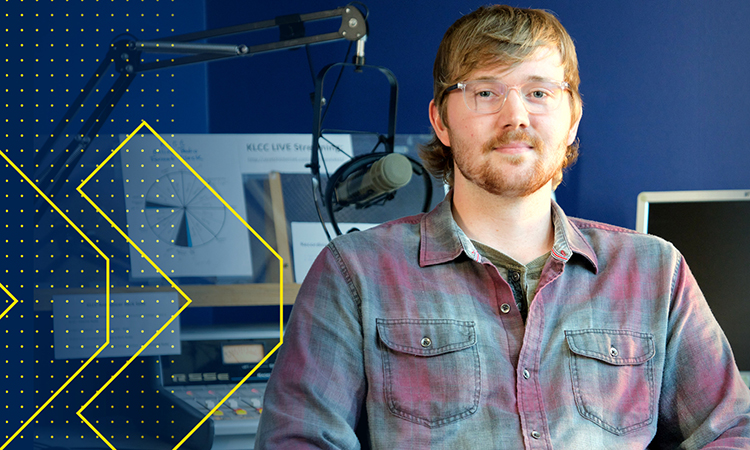
Tune in to KLCC, Iowa Lakes Community College’s online radio station, where creativity meets broadcasting! Operated by students in the Digital, Social, and Broadcast Productions program, KLCC offers a platform to explore, create, and share content with a live audience. From music and podcasts to community news and special events, KLCC provides a dynamic space for hands-on learning in a professional broadcasting environment.
Students gain real-world experience in audio production, programming, and radio hosting, all while using industry-standard tools and software. Whether you’re behind the mic or managing the tech, KLCC is the perfect place to develop your skills and build a portfolio.
Listeners can enjoy a diverse range of music genres, local updates, and student-produced shows that reflect the creativity and energy of Iowa Lakes. Stream KLCC live and discover how our students bring their passion for broadcasting to life.
Hands-On
Training
Career-Ready
Day One
Opportunities, Earnings & Growth

Projected Employment Growth
1.1%
Potential Careers
Prepress Technician & Worker, Desktop Publisher, Film & Video Editor, Photographer, Producer, Multimedia Artist & Animator, Photographic Process Worker & Processing Machine Operator, Regulatory Affairs Manager
Projected Earnings
Iowa Workforce
$41,350
Average Salary
US Bureau of Labor
$65,010
Average Salary

START YOUR LAKER JOURNEY IN 4 STEPS!




Questions? Let's Talk
 |
Kevin Tlam Digital, Social & Broadcast Productions Program 712-362-7914 | ktlam@iowalakes.edu |