

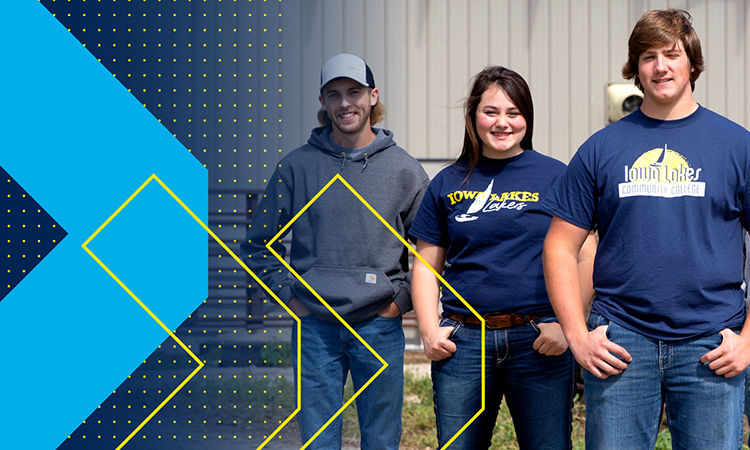
Turn Your Passion for Animals into a Career
Do you want to work with animals or enter the livestock or veterinary industries? The Animal Science Transfer Major at Iowa Lakes combines coursework in animal science, biology, math, and economics to prepare you for transfer to a four-year university and future career success.
Designed for smooth transfer to Iowa’s Regent Universities—including Iowa State University, the University of Iowa, and the University of Northern Iowa—and other four-year institutions, this AS Degree provides a strong foundation for further study in animal science, veterinary medicine, or livestock management.
Through courses like Survey of the Animal Industry, Beef Cattle Science, and General Biology, students gain vital skills for animal care, health, and production.
Engaging Curriculum with Real-World Applications
Key areas of study include:
- Livestock Management – Learn practices for animal care and productivity.
- Biology I & II – Build a scientific understanding of animal health.
- Microeconomics & Statistics – Develop data analysis and business decision-making skills.
Build a Career in Animal Science
Animal science professionals are in high demand across livestock production, veterinary care, and research, check out U.S. Department of Labor Occupational Outlook Handbook – Animal Science to learn more! Ready to take the next step? Connect with an enrollment coach today and get to it!

Find Your It!
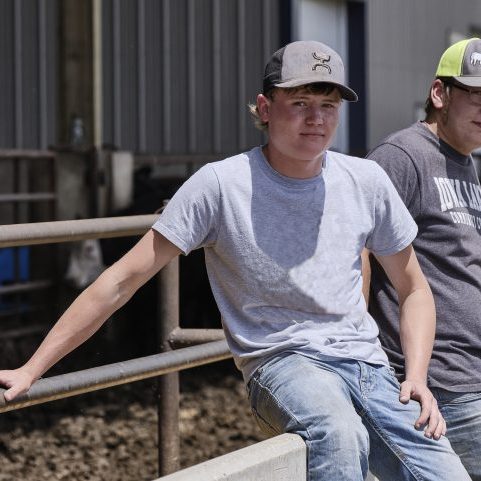
Turn Your Passion for Animals into a Career
Animal Science professionals are in demand across industries, from agriculture to animal hospitals. Our comprehensive coursework provides you with a strong foundation from livestock management to microbiology, taking advantage of our extensive agriculture course options.
A Degree with Purpose
Earn a 64-credit Associate in Science (AS) degree designed for seamless transfer to Iowa’s public universities—including Iowa State University, the University of Iowa, and the University of Northern Iowa—or other four-year institutions. This program prepares you for advanced study in animal science, veterinary medicine, or related fields in agriculture and animal care.
Program Details
Length

4 terms
Degree
Associate in Science (64 credits)
Campus
All Campuses & Online
Your Career Pathway: Additional Degree & Certificate Options
Additional Information
Term 1
AGS 113 – Survey of the Animal Industry
This course is an introduction in animal science including various species and breeds of domestic animals and gives them an appreciation for the principles of production, biological principles, stewardship, and animal industries as they relate to animal production in the U.S. and the world.
BIO 112 – General Biology I
Introduction to biology concepts with emphasis on ecology, cellular biology, reproduction and development, genetics and evolution. Lecture and laboratory.
ENG 105 – Composition I
Emphasis on expository and argumentative writings including a review of usage and mechanics.
Prerequisites: Satisfactory score on the ACT, Accuplacer, ASSET, COMPASS as determined by Iowa Lakes policy
MAT 120 – College Algebra
Operation of real and complex numbers; factoring; exponents; quadratic equations; inequalities; matrices; rational functions; logarithmic functions; and graphing or functions .
Prerequisites: Appropriate placement score or MAT 110 – Math for Liberal Arts
MAT 121 – College Algebra
Topics include linear functions and inequalities; quadratics; conics; polynomials and rational functions; exponential and logarithmic functions; linear systems; matrices and determinants. Additional topics may include sequences, series, permutations, combinations and probability.
Prerequisites: appropriate placement score or MAT 110, MAT 140, MAT 156 or MAT 157
SDV 103 – Successful Learning
Students master the academic and personal skills needed to succeed in higher education and in life. Content will cover academic, communication and life management skills. Goal setting, time management, note taking, test taking and how to be a lifelong learner will also be covered.
Choose MAT 120 or MAT 121
HUMANITIES: 3 CREDITS
Term 2
BIO 113 – General Biology II
Introduction to biology concepts with emphasis on kingdoms; taxonomy and a survey of invertebrate and vertebrate organisms; plant structures and physiology; and animal systems. Lecture and laboratory.
Prerequisites: BIO 112 – General Biology I
CSC 110 – Intro to Computers
CSC-110 is an introductory course that surveys a variety of topics to include history, hardware, software, terminology, communications, computer ethics, and societal impact of computers. In addition to computer literacy, students will complete hands-on modules using operating systems, word processing, database, presentation, and spreadsheet software; such as Microsoft Office programs.
ENG 106 – Composition II
Continuation of ENG 105 with emphasis on research and documentation as well as literary analysis.
Prerequisites: ENG 105 – Composition I
MAT 156 – Statistics
This course provides a foundation of statistical concepts and procedures that can aid the student as both a consumer and producer of statistical information. The course emphasizes descriptive and inferential statistical methods, probability, estimation, hypothesis testing and linear regression. Students are introduced to technology as it applies to introductory statistical methods.
Prerequisites: appropriate placement score or MAT 110, MAT 140, MAT 120, MAT 121, MAT 127 or MAT 210
MAT 157 – Statistics
This course provides a foundation of statistical concepts and procedures that can aid the student as both a consumer and producer of statistical information. The course emphasizes descriptive and inferential statistical methods, probability, estimation, hypothesis testing and linear regression. Students are also introduced to software as it applies to introductory statistical methods.
Prerequisites: Appropriate placement score or MAT 110, MAT 140, MAT 120, MAT 121, MAT 127 or MAT 210
Choose MAT 156 or MAT 157
ELECTIVES: 3 CREDITS
Term 3
AGS 226 – Beef Cattle Science
Beef Cattle Science studies the practical application of modern production and management practices with regards to cow/calf, feeder cattle and beef cattle finishing, with an emphasis on management of nutrition, reproduction, health, husbandry and breeding selection. Economics of beef cattle production are also studied.
CHM 151 – College Chemistry I
The first of two general survey courses introducing the student to general, organic and biological chemistry. Topics covered are chemical calculations, atomic structure, nuclear chemistry, periodic relations, gas laws, solid state, solutions, and acids and bases. Lecture and laboratory.
CHM 166 – General Chemistry I
The properties of matter in terms of modern chemical principles. The topics covered are measurements, stoichiometry, atomic structure, chemical reactions, periodic relationships, gas laws, thermochemistry, quantum theory, solutions and equilibrium and inter-and intra-molecular forces. Problem solving in each of the areas is included. Lecture and laboratory.
Prerequisites: High school chemistry and mathematics
SPC 101 – Fundamentals of Oral Communication†
The fundamentals course develops the basic skills involved in a variety of communication situations, including oral presentations and interpersonal speaking. Emphasis is placed on organization, audience analysis, vocal and physical delivery, listening, nonverbal communication, critical thinking, and methods of dealing with communication apprehension through class discussion and activities.
SPC 112 – Public Speaking
This course examines both the theoretical and practical basis of speech communication, particularly public speaking. Emphasis is placed on speech preparation, organization, support, delivery, and audience analysis.
SPC 122 – Interpersonal Communications
Examines how humans communicate in one-on-one situations through personal and professional relationships.
Choose CHM 151 or CHM 166
Choose SPC 101, SPC 112 or SPC 122
ELECTIVES: 6 CREDITS
Term 4
ECN 130 – Principles of Microeconomics
Reviews the organization and workings of modern economic systems; the role of markets, prices and competition in the promotion of economic welfare, alternative systems and international trade.
MATH OR SCIENCE: 3 CREDITS
SOCIAL SCIENCE: 3 CREDITS
ELECTIVES: 6 CREDITS
General Education & Program Learning Outcomes
By obtaining an Associate in Science (AS) degree from Iowa Lakes, you will learn the following:1
Communications:
- Students are able to communicate clearly, both written and oral using the correct medium.
- Students are able to support ideas with appropriate and adequate information.
Sciences:
- Demonstrate safe laboratory practices.
- Apply scientific inquiry/scientific method to answer questions about the natural world.
Mathematics:
- Apply mathematical methods to solve real world problems.
- Evaluate the validity of mathematical solutions.
Social Sciences:
- Students will demonstrate critical thinking skills in written and oral communication.
- Students will critique the diversity of human experience, individually and collectively.
Humanities:
- Respond critically using established aesthetic principles or criteria, or an ethical judgement of specific examples as it relates to the discipline.
- Express the principles of the discipline within the global community by using the language, syntax, and cultural context of the discipline appropriately.
Computers:
- Integrate the technology necessary in the workplace environment.
- Demonstrate knowledge in utilizing software application tools.
1The What You’ll Learn section of our website provides a description of Learning Outcomes for students who successfully complete all requirements for obtaining an Agriculture Production Technology Associate in Applied Science degree from Iowa Lakes Community College.
OUR FARM FEATURES:
AGRONOMY
- 250 Acres of Row Crop
- Precision Ag Technology (GPS)
SWINE OPERATION
- Farrow-to-Finish
- PigCHAMP – leading swine management software
BEEF OPERATION
- Monoslope Cattle Barn
- Custom Feedlot
- Electronic Identification
- Performance Beef – industry-leading feedlot technology
- Cow-Calf Herd
NEWLY CONSTRUCTED FARM LAB FACILITY
- 7,600-square-foot building
- Modern and innovative classroom
- Shop area for machinery repair
- Advanced technology simulation lab
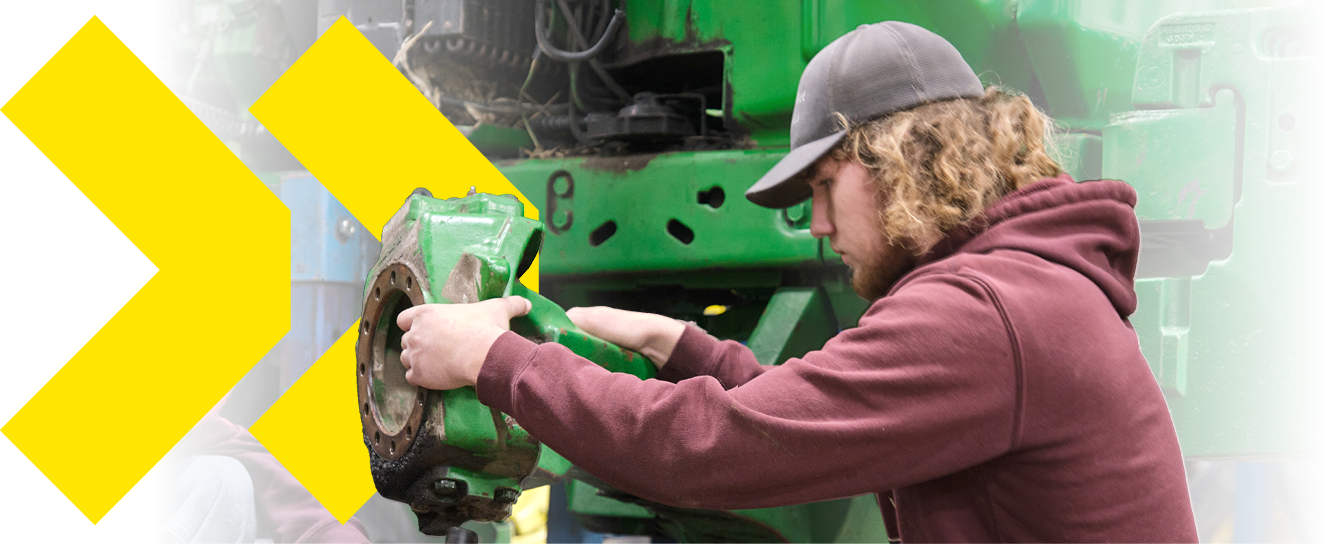
Hands-On
Training
Career-Ready
Day One
Transfer data to Iowa Regent Universities

First Year University GPA
Note: This is the average of transfer with associates and transfer, no associates
2.94
Average Retention One Year After Transferring to a Regent University
86%
Average University Graduation Rates Three Years After Entry to a Regent University
58%

START YOUR LAKER JOURNEY IN 4 STEPS!




Questions? Let's Talk
 |
Andrea Japenga Academic Advisor 712-852-5241 | ajapenga@iowalakes.edu |