
Jumpstart Your Career with an Electrical Maintenance Technician Diploma
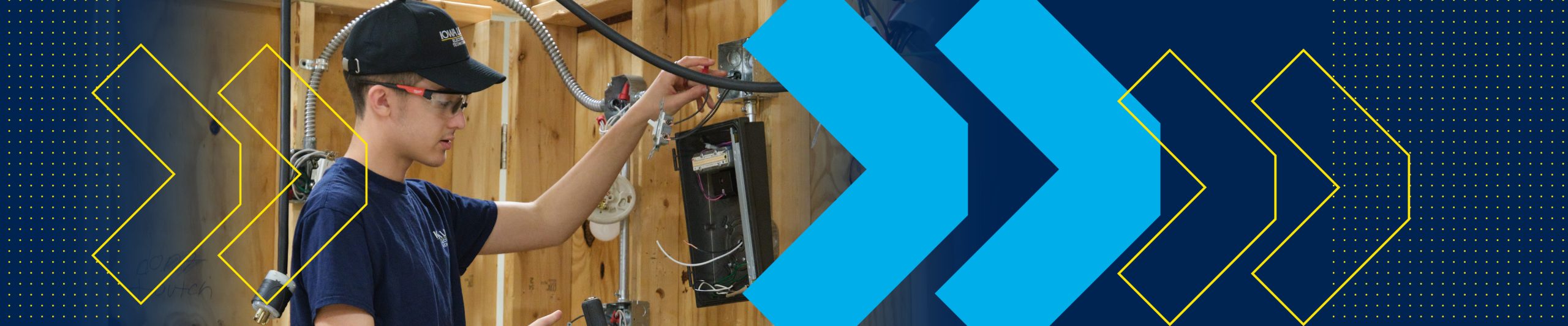
Looking for a fast-track path to a high-demand career in the electrical industry? The Electrical Maintenance Technician Diploma at Iowa Lakes provides hands-on training and industry certifications to prepare you for entry-level roles in electrical maintenance, industrial systems, and renewable energy technology. In just three terms, you’ll develop the technical expertise needed to install, maintain, and troubleshoot electrical systems in residential, commercial, and industrial settings.
At Iowa Lakes, you’ll train in state-of-the-art electrical labs, gaining experience with power distribution, motor controls, programmable logic controllers (PLCs), and electrical safety standards. Our practical curriculum and industry partnerships ensure you graduate job-ready with real-world experience. Many students secure employment before completing the program, thanks to the connections Iowa Lakes has made with electrical contractors, manufacturing facilities, and energy companies.
Explore career opportunities and salary projections through the U.S. Bureau of Labor Statistics Electricians Outlook.
Connect with an enrollment coach today and take the first step toward an exciting career in electrical maintenance!

Find Your It!

Hands-On Training & Career Pathways
Develop the Skills Needed for a High-Demand Industry
The Electrical Maintenance Technician Diploma program provides in-depth technical training in:
- Electrical maintenance and troubleshooting – Learn to service, repair, and install electrical systems
- Motor controls and power distribution – Gain expertise in industrial and commercial electrical applications
- Programmable Logic Controllers (PLCs) – Develop automation skills for manufacturing and industrial settings
- Renewable energy systems – Learn about solar and wind energy technologies
- Electrical safety and national code compliance – Train to meet OSHA standards and NEC regulations
Graduates of the Electrical Maintenance Technician Diploma program are prepared for various in-demand careers in the electrical industry. Many find opportunities to be Electrical Maintenance Technicians responsible for maintaining and repairing electrical systems in industrial and commercial buildings. Others work as Industrial Electrician Assistants, supporting licensed electricians with installations, troubleshooting, and power system maintenance.
With the increasing focus on renewable energy, some graduates specialize as Renewable Energy Technicians, installing and maintaining solar and wind energy systems. Additionally, those interested in facility management can pursue careers as Facilities Maintenance Technicians, overseeing electrical systems in factories, schools, and large commercial buildings. With electrical maintenance professionals in high demand, Iowa Lakes equips students with the technical training, certifications, and real-world experience needed to launch a successful and high-paying career in this growing field.
Program Details
Length

3 Terms
Degree
Diploma (42 credits)
Campus
Estherville
Your Career Pathway: Additional Degree & Certificate Options
Additional Information
Term 1
COM 753 – Technical Communications†
This course is designed to prepare students for the oral and written communication situations in the working world. The major areas of study include technical communication principles, oral communications, composing technical documents, and using Standard English. Writing projects require the use of a word processing program; therefore, computer experience is recommended.
ELE 119 – Basic Electricity I
Electrical Theory I is an introduction to basic electrical theory and components that make up electrical circuits. Direct Current and Alternating Current will be introduced and basic laws for voltage, current and power relationships will be presented in lecture and laboratory format. Course content will include, but not be limited to basic circuits, electrical components and their applications. Hands-on reinforcement of theory covered during lecture is practiced in lab.
ELE 155 – NEC I
An introduction to the NFPA 70® National Electrical Code®. The course covers Chapters 1 and 2 of the Code, including the structure of the Code, requirements of electricians, and basic wiring and protection.
ELE 181 – Residential Electric/Electronics Systems
This course is designed to introduce students to residential wiring. Discussion topics will include safety, planning, using residential building plans, calculating loads, and wiring methods. Lab settings will require the student to use hand tools and wire circuits. The National Electrical Code will be used in depth to determine the requirements used for residential wiring. We will be using hand and power tools in the labs for wiring practices and installations.
MAT 743 – Technical Math
Technical Math includes operations with real numbers, use of fractions, ratios, measurement conversion, algebraic equations, functions, geometry, and right angle trigonometry. Applications are designed around situations students may encounter in industrial settings
SER 114 – Blueprint Reading
Fundamentals, principles, and practices involved in producing and reading blueprints utilized in the different sectors of the renewable energy industry with a focus on basic blueprint reading.
SER 116 – Career Seminar
A study of the careers available within the renewable energy sector, with an emphasis on analyzing renewable energy industries as related components of a dynamic system. Students will also learn about drafting cover letters, creating resumes, interviewing, and networking.
Term 2
BUS 102 – Intro to Business
The basic fundamentals of business. Basic business and economic concepts and terminology; management, marketing, finance, human resource management, accounting and other business areas.
ELE 136 – Basic Electricity II
Electric Theory II consists of instruction that will build upon experience gained in Electric Theory I. Students will be introduced to advanced concepts of electrical theory.
ELE 156 – NEC II
A continuation of the NFPA 70® National Electrical Code®. The course covers Chapters 3 and 4 of the Code, including wiring methods, materials, and general equipment.
Prerequisites: ELE 155 – NEC I
ELE 195 – Motor Control
This course discusses motor controls, components, operation, and service. Students will learn electric relay control of AC and DC motors along with troubleshooting motors in an industrial application.
ELE 354 – Commercial Electric/Electronics Systems
This course introduces students to commercial wiring. It begins with the planning of the commercial installation by using blueprints, layout, and calculations. They will be required to calculate load for branch circuits, feeders and the electrical service. Wiring methods, luminaires, motors and overcurrent protection will also be covered. The National Electrical Code requirements will be used and explained to understand how they are applied to commercial installations. The labs will consist of bending conduit and use hand tools for wiring methods and practices.
Prerequisites: ELE 181 – Residential Electric/Electronics Systems
SER 205 – Solar Energy Concepts
This class will introduce students to various solar energy concepts that a technician should understand while working on or around photovoltaic (PV) installations.
Prerequisite: ELE 119 – Basic Electricity I
Corequisites: ELE 136 – Basic Electricity II & ELE 195 – Motor Control
Term 3
ELE 946 – Electrical Technology Internship I
Students will complete job contact experience in their field of choice. A minimum of 432 job contact hours is required by this 6-credit course.
General Education & Program Learning Outcomes
In the Electrical Maintenance Technician program at Iowa Lakes, you will learn how to:1
- Install electrical components and equipment.
- Interpret electrical blueprints, diagrams, and schematics.
- Diagnose issues with electrical components and equipment.
- Employ electrical wiring codes and regulations in accordance with the National Electrical Code.
- Perform daily tasks utilizing electrically safe work practices according to OSHA standards and the NFPA 70E Electrical Safety in the Workplace.
- Determine wiring for control, instrumentation, communications and power systems in residential, commercial and industrial applications.
1The What You’ll Learn section of our website provides a description of Learning Outcomes for students who successfully complete all requirements for obtaining an Electrical Technology Associate in Applied Science degree from Iowa Lakes Community College.
Industry Certifications & Workforce Readiness
Employers look for certified technicians, and Iowa Lakes ensures students receive training and credentials that enhance job opportunities, including:
- OSHA 10 & OSHA 30 safety certifications
- National Electrical Code (NEC) compliance training
- PLC and automation certifications
With Iowa Lakes strong industry partnerships Iowa Lakes has formed, students gain real-world experience through internships and on-the-job training programs, ensuring they graduate with the skills employers demand.
The Electrical Maintenance Technician program at Iowa Lakes allows students to work on real industrial systems, learning automation, power controls, and renewable energy applications—helping them stay ahead in the evolving electrical and energy industries!

Hands-On
Training
Career-Ready
Day One
Opportunities, Earnings & Growth

Projected Employment Growth
.4%
Potential Careers
Residential/Commercial Electrician, Electrical & Electronics Repairer, Telecommunications Equipment Installer/Repairer, First-Line Supervisor of Mechanics, Operating Engineer, Construction Equipment Operator, Power
Distributor & Dispatcher
Projected Earnings
Iowa Workforce
$63,814
Average Salary
US Bureau of Labor
$67,810
Average Salary

START YOUR LAKER JOURNEY IN 4 STEPS!




Questions? Let's Talk
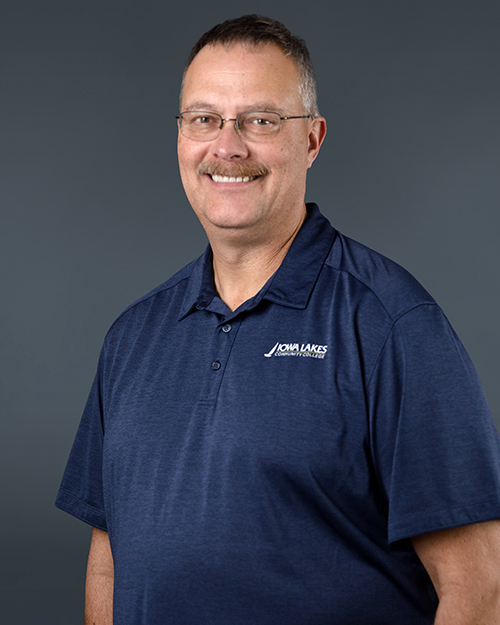 |
Doug Zemler Assistant Professor, Electrical Technology Instructor & Coordinator 712-362-8376 | dzemler@iowalakes.edu |